Dry camping, or boondocking, hinges on dependable off-grid power. The right 12V battery keeps lights on, appliances running, and devices charged without frequent trips to a shore power outlet. This guide highlights five top Amazon options that blend safety, long life, and practical performance for RV setups. From maintenance-free AGM batteries to a compact lithium option and a solar charging kit, these selections cover common dry-camping scenarios and expandability needs.
Choosing the right battery affects how long you can stay off-grid, how much weight you haul, and how smoothly your daily routines go on the road. Below is a quick summary of the five products chosen for dry camping, followed by detailed sections that outline each option’s strengths, configurations, and ideal use cases. Each choice balances reliability with practical considerations like space, temperature tolerance, and maintenance needs.
| Product | Brand | Type | Key Benefit |
|---|---|---|---|
| Renogy Deep Cycle AGM 12V 100Ah | Renogy | AGM Deep Cycle | Safe, maintenance-free, high discharge capability |
| WEIZE Deep Cycle AGM 12V 100Ah | WEIZE | AGM Deep Cycle | Low self-discharge, compact size, solid for RVs |
| WEIZE 12V 100Ah Deep Cycle Battery | WEIZE | Sealed Lead Acid (AGM-SLA) | Strong max discharge and robust build |
| Go Power Overlander 200W Solar Kit | Go Power | Solar Panel Kit (with PWM Controller) | Expandable solar charging for off-grid power |
| ECO-WORTHY 12V Lithium 20Ah | ECO-WORTHY | Lithium Iron Phosphate (LiFePO4) | Long cycle life, high energy density, lightweight |
Renogy Deep Cycle AGM 12V 100Ah Battery

Renogy’s AGM Deep Cycle 12V 100Ah battery combines safety with rugged reliability. The sealed AGM design minimizes acid leakage and allows maintenance-free operation, which is ideal for RV cabinets and tight storage spaces. The chemistry offers a stable charge profile and a low self-discharge rate around 3%, making it suitable for extended storage between trips.
With a maximum discharge current of 1100A, this battery handles high-load appliances when needed. It also supports flexible system configurations: series connections without limitation and parallel connections up to four units, enabling larger RV power banks for ambitious dry-camping setups. The battery’s sealed design reduces the likelihood of leaks or spills during travel, adding an extra layer of safety in mobile environments.
Renogy has earned broad trust, with a large installed base and a reputation for durable, weather-resilient products. This 100Ah option provides a dependable baseline for most RV power needs, balancing capacity, safety, and ease of use without requiring special maintenance or exotic charging schemes.
WEIZE Deep Cycle AGM 12V 100Ah Battery
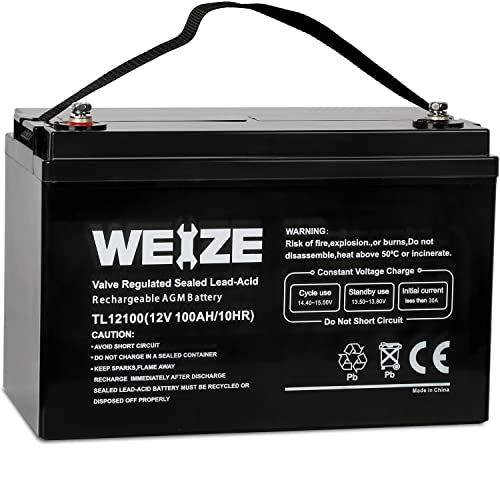
WEIZE’s 12V 100Ah sealed AGM battery emphasizes maintenance-free operation and safety. The compact dimensions (approximately 12.99 x 6.73 x 8.43 inches) make it a versatile fit for many RV storage compartments. Its 3% self-discharge rate and a high max discharge current (up to 1100A) support both critical appliances and livable comfort during longer dry-camping stretches.
Designed for practical RV use, the WEIZE battery delivers reliable performance across a broad operating temperature range, enabling charging and discharging in varied climates. Its sealed construction reduces risk of acid leaks and makes it a convenient choice for owners seeking a straightforward, drop-in replacement for older flooded batteries.
In daily use, this battery is well-suited to powering RV lights, fans, and small appliances while offering predictable performance in a range of outdoor conditions.
WEIZE 12V 100Ah Deep Cycle Battery

This WEIZE model is another 12V 100Ah deep cycle option from the same brand, with a sealed lead-acid design built for reliability in RV and off-grid setups. It lists a 1150A max discharge current for robust loads and a similar 1–3% monthly self-discharge profile, enhancing energy retention during longer stints off power.
The battery emphasizes practical dimensions and solid lifecycle expectations, making it a strong candidate for dry camping where weight and space are at a premium. The terminals follow standard configurations (Left: Positive (+), Right: Negative (-)), aiding straightforward replacement in existing systems.
Overall, this WEIZE variant provides dependable performance for RV lighting, refrigeration fans, and other essential loads while keeping maintenance minimal and predictable.
Go Power Overlander 200W Solar Kit

This solar charging kit delivers a robust 200 watts of solar power with a 9.6-amp charging capability, making it well-suited for maintaining RV batteries during extended dry camping. The kit is designed for easy maintenance-free operation, helping keep batteries topped up without daily generator runs.
One of the kit’s strengths is expandability: the included 30-amp PWM controller supports additional solar input up to 600 watts, enabling future system growth as energy needs evolve. The kit also includes two 25-foot solar output cables (male and female), facilitating flexible placement of panels for optimal sun exposure.
For RVs relying on solar energy to complement stored power, this kit provides a practical, scalable route to reliable off-grid charging and extended camping durations.
ECO-WORTHY Portable 12V Lithium Battery 20Ah

This ECO-WORTHY portable lithium battery uses a LiFePO4 chemistry with a built-in BMS and 4000+ charge-discharge cycles. The compact 12.8V nominal, 20Ah capacity is ideal for lightweight, small-load RV applications or as a supplemental power source for critical electronics and USB devices when paired with a small inverter or DC-USB charger.
The battery’s built-in protection and long cycle life translate into lower long-term maintenance and replacement frequency. Its compact dimensions (approximately 8.7 x 4.5 x 4.6 inches) and portable form factor make it easy to transport for camping trips and emergency power needs.
In dry camping scenarios where weight savings and extended cycle life matter, a LiFePO4 option like this can be a compelling choice for supplementing larger AGM batteries or powering essential devices with minimal risk of leakage or corrosion.
Buying Guide: How To Choose The Right RV Battery For Dry Camping
Understand the core tradeoffs to select the best battery for your system. The main considerations are chemistry, capacity, discharge capability, size and weight, operating temperature, maintenance, and charging compatibility. The right mix depends on how long you stay off-grid, your power load, and how much you’re willing to invest upfront for longer life and performance.
- Battery Chemistry: AGM (stored energy in sealed lead-acid) vs Lithium Iron Phosphate (LiFePO4). AGM batteries are affordable, maintenance-free, and rugged, but heavier and with shorter cycle life. LiFePO4 offers longer cycle life, deeper usable capacity, and lighter weight, but at a higher upfront cost.
- Capacity and Depth of Discharge: A higher amp-hour (Ah) rating provides more usable energy. For dry camping, consider how many days you typically go between top-ups and what devices you run (lights, fridge, fans, chargers).
- Max Discharge Current and C Rate: Discharge current limits determine how many high-drain appliances you can run simultaneously. Models shown range from about 1100A to 1150A max discharge in the data provided, which supports powering multiple loads briefly.
- Self-Discharge Rate: AGM batteries commonly hover around 3% per month, while LiFePO4 cells can hold their charge longer with minimal self-discharge. Lower self-discharge helps when you store the battery between trips.
- Temperature Tolerance: Cold temperatures reduce battery performance. Look for batteries rated to function well in your typical camping climate (e.g., 14°F to 122°F ranges for some AGM models).
- Maintenance and Safety: Sealed batteries reduce spills and venting concerns. LiFePO4 batteries require proper handling but offer consistent voltage and longer cycles; AGM batteries are also maintenance-free but heavier.
- Charging Options and Compatibility: If you rely on solar, choose batteries compatible with your panels and controllers. Some kits include PWM controllers and extension cables for easier setup and expansion.
- System Expandability: If you plan to add more capacity later, ensure the battery bank can be expanded via series/parallel connections without major rewiring.
- Size, Weight, and Mounting: Space-constrained RVs benefit from compact dimensions and lighter weights, especially when upgrading from older lead-acid batteries.
- Warranty and Availability: Look for reputable brands with clear warranty terms and easy access to replacement units or support when needed.
| Product | Chemistry | Voltage | Capacity (Ah) | Max Discharge (A) | |
|---|---|---|---|---|---|
| Renogy Deep Cycle AGM 12V 100Ah | AGM | 12V | 100 | 1100 | 3% self-discharge; series/parallel capable |
| WEIZE Deep Cycle AGM 12V 100Ah | AGM | 12V | 100 | 1100 | 1–3% self-discharge; solid RV option |
| WEIZE 12V 100Ah Deep Cycle | AGM | 12V | 100 | 1150 | Sealed lead-acid; typical RV use |
| Go Power Overlander 200W Solar Kit | Solar Kit with PWM Controller | — | — | — | Expandable up to 600W; good for keeping batteries charged |
| ECO-WORTHY 12V LiFePO4 20Ah | LiFePO4 | 12.8V | 20 | — | 4000+ cycles; built-in BMS; lightweight |
In summary, for many RV setups, an AGM 12V 100Ah battery offers a strong mix of safety, reliability, and value. If weight, longer life, and deeper usable capacity are priorities—and you’re willing to invest more upfront—a LiFePO4 solution like the Eco-Worthy option can pay dividends over time. Complementing these with a solar kit such as Go Power Overlander helps maintain battery charge during extended dry-camping stays and reduces generator use.